
Rooftop Commercial Solar is the perfect solution for businesses, offices, shopping malls, hotels, hospitals, and commercial buildings looking to reduce electricity costs dramatically. Install solar panels on your unused rooftop space and generate your own clean, affordable electricity for 25+ years. With 3-5 year payback period and 20-40% electricity bill reduction, commercial rooftop solar delivers exceptional ROI while meeting your ESG and sustainability goals.
Get Free QuoteRooftop commercial solar involves installing photovoltaic (PV) solar panels on the rooftops of commercial buildings, offices, factories, warehouses, malls, hotels, hospitals, and other business establishments. These solar panels convert sunlight directly into electricity that powers your facility during daytime operations, reducing dependency on expensive grid electricity.
Commercial rooftops are ideal for solar installations because they typically have large, unobstructed, shadow-free spaces that would otherwise remain unutilized. A typical commercial building with 10,000 sq.ft. rooftop can install 100-150 kW solar capacity, generating approximately 150,000-225,000 units of electricity annually – enough to power significant portion of the building’s energy needs.
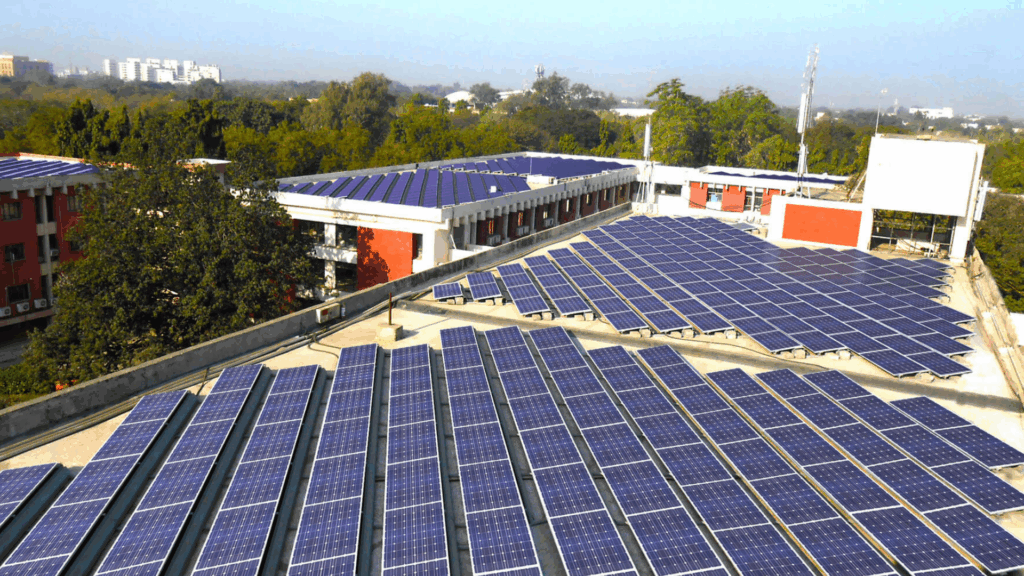
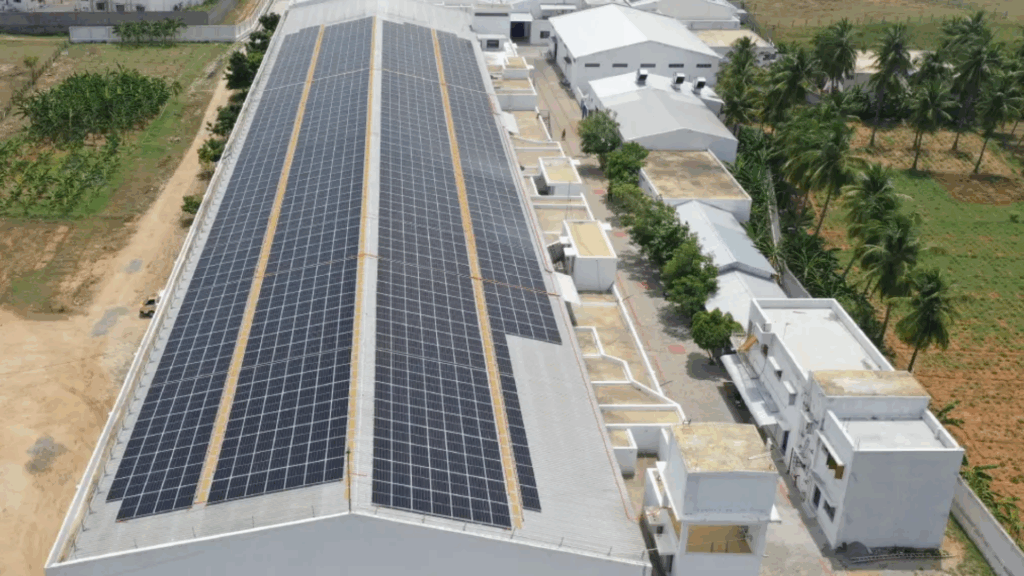
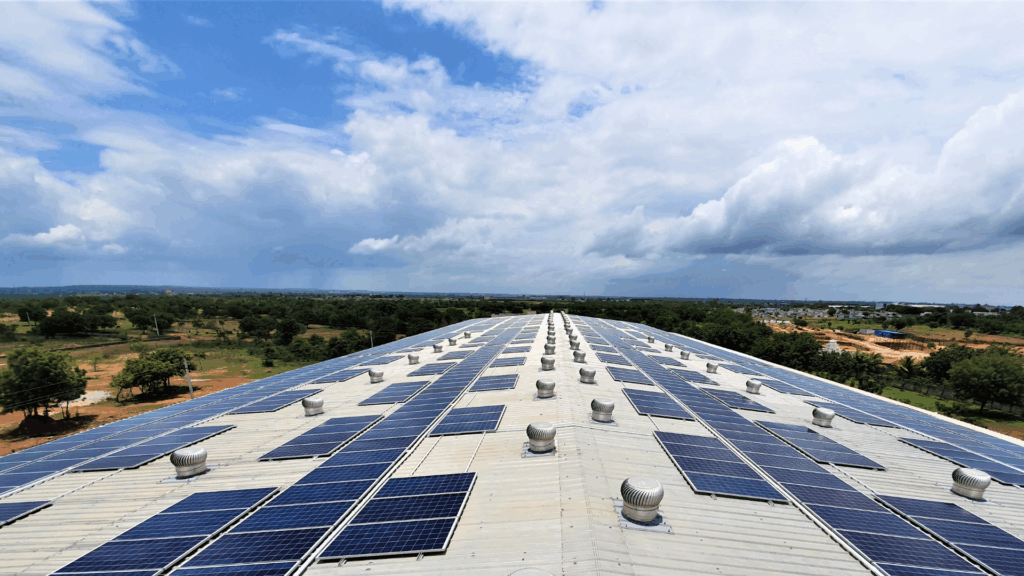
Rule of Thumb: Every 100 sq.ft. of shadow-free rooftop can accommodate approximately 1 kW solar capacity. A typical commercial solar panel (540W) requires about 25 sq.ft. space including spacing for maintenance access.
5,000 sq.ft. rooftop: Can install 40-50 kW system generating 60,000-75,000 units annually, saving ₹3-4 Lakhs per year.
10,000 sq.ft. rooftop: Can install 80-100 kW system generating 120,000-150,000 units annually, saving ₹6-8 Lakhs per year.
20,000 sq.ft. rooftop: Can install 160-200 kW system generating 240,000-300,000 units annually, saving ₹12-16 Lakhs per year.
System Specifications: 100 kW rooftop solar using 185 panels of 540W each. Requires approximately 8,000-10,000 sq.ft. rooftop space. Annual generation: 150,000 units (4 hours average daily generation).
Investment Required: Total project cost ₹45-50 Lakhs (₹45,000-50,000 per kW) including panels, mounting structures, inverters, cabling, installation, net metering, and commissioning.
Annual Savings: Grid electricity at ₹9/unit costs ₹13.5 Lakhs annually. Solar electricity at ₹3/unit (LCOE) costs ₹4.5 Lakhs. Net annual savings = ₹9 Lakhs.
Payback Analysis: With ₹9 Lakhs annual savings and ₹50 Lakhs investment, simple payback is 5.5 years. However, with 40% accelerated depreciation benefit (₹20 Lakhs tax savings at 30% tax rate = ₹6 Lakhs), effective payback reduces to 4.8 years.
25-Year Returns: Total electricity generated over 25 years (accounting for 0.5% annual degradation) = 3.6 million units. At ₹9/unit grid cost = ₹3.24 Crore value. After deducting ₹50 Lakhs investment and ₹10 Lakhs maintenance costs = Net savings of ₹2.64 Crore over 25 years. IRR of 22%.
Step 1: Site Assessment (1-2 days) – RVR Solar conducts comprehensive rooftop survey measuring available space, structural integrity, shading analysis, electrical infrastructure, and grid connectivity. Free drone-based shadow analysis and 3D system design provided.
Step 2: System Design & Proposal (3-5 days) – We prepare detailed project report with exact system capacity, panel layout, electrical single-line diagram, generation estimates, financial analysis, and ROI calculations. Customized proposal matching your energy consumption patterns.
Step 3: Approvals & Permits (15-30 days) – RVR handles all regulatory approvals including structural stability certificate, fire safety NOC, electricity board permissions, net metering application, and building owner consent. We manage the entire approval process.
Step 4: Installation (15-30 days) – Professional installation by certified technicians. Mounting structure installation, panel mounting, inverter setup, DC/AC cabling, earthing, lightning protection, and grid synchronization. Minimal disruption to your business operations.
Step 5: Testing & Commissioning (2-3 days) – Comprehensive system testing including insulation test, polarity check, inverter calibration, grid synchronization, net meter installation, and performance validation. Official commissioning with electricity board inspection.
Step 6: Monitoring & Maintenance (25 years) – Real-time monitoring system installed with mobile app access. RVR Solar provides 25-year operations and maintenance with quarterly cleaning, annual inspections, and breakdown support. Performance guarantee of 95%+ system availability.
Net metering allows you to export excess solar power to the grid and receive credit on your electricity bill. During sunny hours when solar generation exceeds your consumption, surplus power flows to grid. During evening/night when solar doesn’t generate, you draw power from grid using your accumulated credits.
How it works: Bi-directional meter tracks both import (from grid) and export (to grid). Net consumption = Import units – Export units. You pay only for net consumption at normal tariff. In Tamil Nadu, net metering available for systems up to 1 MW capacity under Tamil Nadu Electricity Regulatory Commission regulations.
Banking facility: Unused solar units can be banked for up to 12 months. Perfect for businesses with seasonal consumption patterns. Maximizes value of your solar investment by ensuring no generated unit goes waste.